
Not every keyword is worth 2,000 words anymore, and not every keyword should be surrendered to an AI Overview either. The difference comes down to whether the query has one right answer or requires judgment, and most content teams are still writing as if every query is the same.
Key takeaways
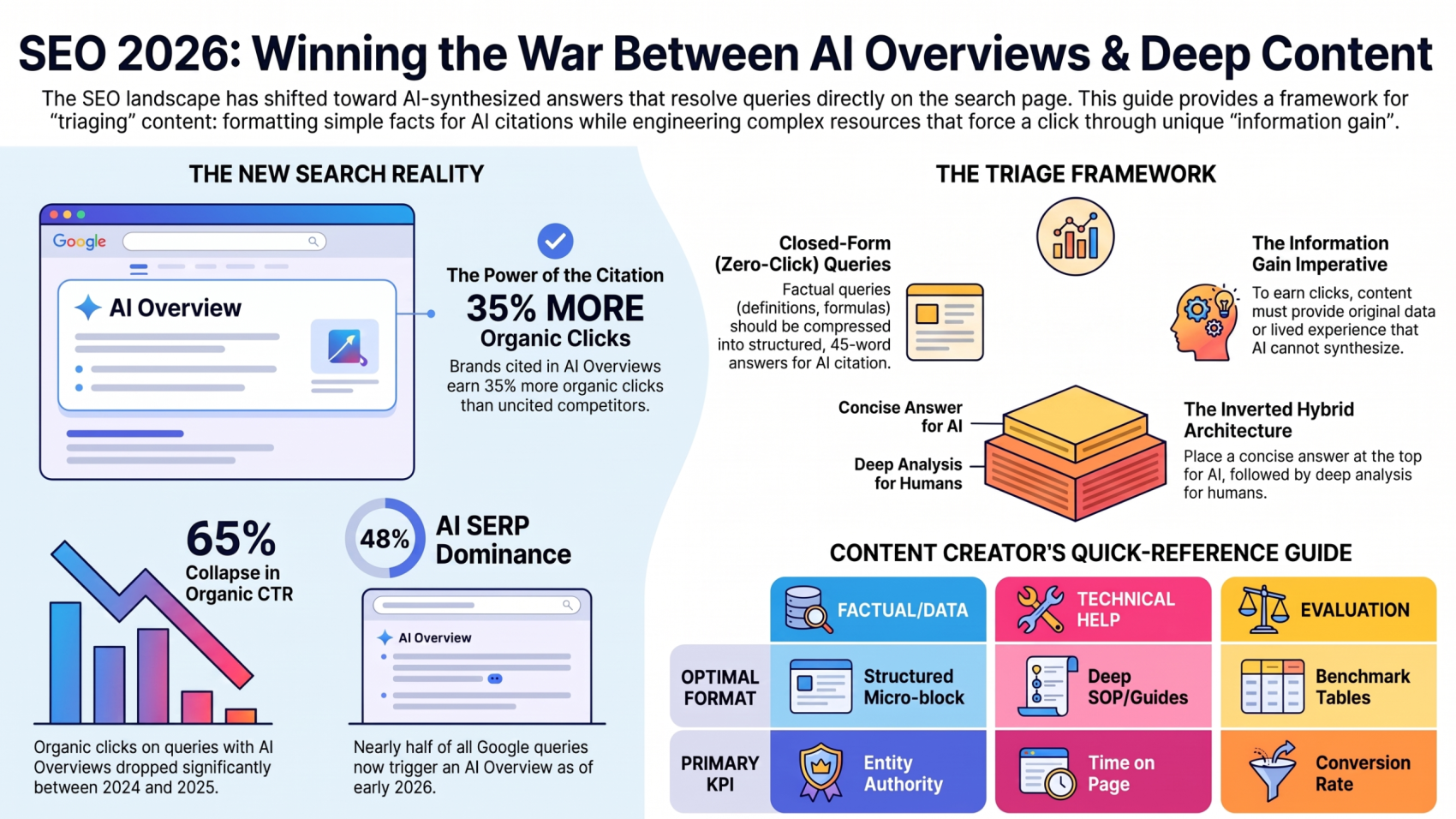
- Organic CTR on queries with an AI Overview fell from 1.76% to 0.61% between June 2024 and September 2025, an industry-tracked 65% collapse, according to Seer Interactive's longitudinal study of 2.43 billion impressions.
- That decline has since stabilized, not fully recovered. By February 2026, CTR on AI Overview queries had climbed back to roughly 2.4%, still well below the 3.8% baseline for queries without an AI Overview.
- Brands actually cited inside an AI Overview earn about 35% more organic clicks and 91% more paid clicks than uncited competitors on the same query, per the same study. Citation, not ranking position, is now the variable that matters most on these queries.
- The fix is not writing less. It is matching format to query type: compressed, structured answers for closed-form questions, and genuinely deep, original resources for anything AI models cannot resolve in a paragraph.
- The same page can often do both, with a compressed answer at the top and irreducible depth below it, a structure covered later in this piece.
On this page
The AI Synthesis Dilemma: The Shrinking Value of Generic Content
Google's AI Overviews and conversational answer engines stopped acting like indexers a while ago. They act like answers. For a huge share of informational queries, the search results page no longer exists to point somewhere else, it exists to resolve the question on the spot.
The numbers back this up more clearly than most SEO shifts in recent memory. Seer Interactive tracked 2.43 billion impressions across 53 brands and 5.47 million queries over 14 months and found organic CTR on AI Overview queries dropped 65%, from 1.76% down to 0.61%, between June 2024 and September 2025. Pew Research's separate study of real search sessions found something just as blunt: when an AI Overview appears, people click a traditional organic result only 8% of the time, versus 15% without one.
Organic CTR decline on AI Overview queries, June 2024 to September 2025 (Seer Interactive)
More organic clicks earned by brands cited inside an AI Overview vs. uncited competitors
Share of Google queries triggering an AI Overview as of March 2026, varying by vertical
Zero-Click Search Realities: Cannibalization vs. Brand Entity Visibility
None of this means zero-click visibility is inherently bad. It means the value of a query needs to be judged by what kind of visibility is actually available on it, not by whether a click happens. Losing a vanity click on "what does HTTP 429 mean" costs you almost nothing, since that visitor was never going to convert. Losing the chance to be the brand named inside an AI Overview's source carousel on a commercial-adjacent query is a real loss, because that citation carries authority even without a click.
The central skill this piece is built around is picking the right battle for every keyword cluster you own, rather than applying one content strategy to all of them.
Query Deconstruction: Anatomy of a Zero-Click Query vs. an Uncompressable Search
Closed-Form Searches: Why Traditional 2,000-Word Guides Are Obsolete
A closed-form query has exactly one correct answer and no meaningful room for interpretation: a definition, a status code lookup, a unit conversion, a quick formula. "What is a 301 redirect" and "how to calculate burn rate" both belong here. Writing a long article for these queries produces predictably bad outcomes, a high bounce rate and a CTR close to zero, because an AI model can synthesize the entire correct answer directly on the results page in one or two sentences. There is nothing left for a 2,000-word guide to add, and searchers know it before they click.
Multi-Variable and High-Stakes Intent: Queries That Defy AI Compression
Other query classes cannot be resolved in the 40 to 60 words an AI Overview typically allots to an answer, no matter how good the underlying model gets:
- Implementation nuance. Troubleshooting an ambiguous bug, integrating several tools with conflicting assumptions, or handling an edge case a generic answer never anticipated.
- High-consequence decisions. YMYL topics, enterprise software evaluations with real budget at stake, and legal or technical architecture decisions where being wrong is expensive.
- Lived experience and primary data. Real client case studies, benchmark numbers from your own work, proprietary teardowns, and informed opinions that no public training corpus contains, because they simply do not exist anywhere else yet.
These categories share one trait: an AI model can only synthesize what has already been written down somewhere. If the value you're offering is judgment, specificity, or data nobody else has published, there is no version of AI compression that can replace it.
The 4-Pillar Content Triage Framework: Choosing Your Format
Run every keyword cluster through these four filters before deciding how to write it.
Filter 1: Answer Compression and Surface Complexity
Ask whether the user's primary intent can be fully resolved in under 50 words. If yes, target a concise, structured answer block or a schema-backed snippet, not an article. If resolving the intent genuinely requires multi-step evaluation or weighing trade-offs, that's your signal to build a long-form resource instead.
Filter 2: The Information Gain Imperative
Google has held a granted patent since 2022 called Contextual Estimation of Link Information Gain, which describes scoring documents by how much new information they add relative to what a searcher has already seen. Nobody outside Google can say for certain how directly that patent maps onto current ranking or AI-citation behavior, but the underlying logic clearly does: if your long-form piece only rephrases what's already sitting in the top 10 results, an AI Overview will commoditize it instantly. Long-form only earns its length when it contributes something the model cannot already reconstruct: original data points, custom diagrams, a proprietary script, or a real experiment with results nobody else has published.
Filter 3: Downstream Commercial Intent and Conversion Potential
Look past the query's surface wording to the person behind it. An impulse searcher looking up "HTTP 429 meaning" wants a fact and nothing else. An engineer or manager evaluating how to fix recurring rate-limiting errors across a production system is closer to a buyer. Spend long-form resources strictly where there's a realistic path to a newsletter signup, a product sale, or a consulting inquiry at the end of it, not on queries that will only ever generate a fact-check visit.
Filter 4: Live SERP Composition and Real Estate
Before committing to a format, actually look at the current results page on both mobile and desktop. Check whether the query triggers a large AI Overview that pushes everything else below the fold, or whether Google is still surfacing rich carousels, forum and community discussions, and genuine organic blue links. The SERP itself tells you how much room is left to compete in, and that composition shifts often enough to be worth rechecking before every major content investment.
Execution Playbook: Engineering for Both Outcomes
Tactic A: Capturing AI Citations for Zero-Click Surfaces
When a query calls for a compressed answer, format for the citation, not just the reader:
- Bottom line up front. State the direct definition or answer in the very first sentence, ideally under 45 words, before any framing or preamble.
- Semantic structuring. Use clean HTML tables, ordered lists, and semantic tags like
<dl>,<dt>, and<dd>so the answer's structure is unambiguous to a parser, not just readable to a human. - Structured schema deployment. Implement targeted JSON-LD,
DefinedTermfor glossary-style answers,HowTofor procedures, andFAQPagefor question-and-answer content, so LLMs and AI Overview systems can ingest the answer cleanly rather than having to parse prose.
Read more about NIST standards for trustworthy information retrieval.
Tactic B: Engineering Click Magnets for Deep Content
For the queries that genuinely warrant depth, build pages that make settling for an AI summary a worse option than clicking through:
- Embed downloadable assets: a Notion operating system, a Google Sheets template, a checklist a reader will actually reuse.
- Use annotated screenshots, interactive widgets, and decision trees, formats that cannot be flattened into a plain-text paragraph without losing most of their value.
- Focus explicitly on what went wrong and what post-implementation maintenance looks like. These are the operational realities AI summaries almost never cover, because they require lived experience rather than synthesis of existing text.
The Inverted Hybrid Architecture: Winning Both Formats on a Single Page
How to Structure the Modern Organic Page Layout
Most queries do not force a binary choice between compressed and deep. A well-built page can feed both audiences at once, structured in three layers:
- Hero and top section. A concise, self-contained definition or answer, written specifically to feed crawler summaries and AI Overview extraction, placed before any narrative setup.
- Mid-page expansion. The deep analysis, trade-off comparisons, real-world data, and tactical execution guidance that serves the human reader who needed more than the summary.
- Bottom-funnel conversion. Downloadable tools, templates, or a direct path to a consulting conversation, placed where a reader who has just seen your depth is most persuaded.
This layout means you stop choosing between ranking for the citation and ranking for the click. You compete for both on the same URL.
Zero-Click vs. Long-Form Quick Decision Matrix
| Query Type / Intent | Optimal Format | Target SERP Placement | Primary KPI |
|---|---|---|---|
| Definitional / factual data | Structured micro-block (BLUF) | AI Overview citation / direct answer | Impression share & entity authority |
| Technical troubleshooting | Deep SOP with error scenarios | Organic top 3 + discussion forums | Organic clicks & time on page |
| Tool / platform evaluation | Comparative benchmark table | Organic result / AI reference | Product referrals & conversion rate |
| Operational process / framework | Interactive OS / template hub | Featured snippet + organic blue link | Template downloads & lead capture |
Frequently Asked Questions
Does writing shorter content actually help me get cited in AI Overviews?
Length isn't the variable that matters, structure and information density are. A short answer with no unique information gets ignored just as easily as a bloated one. Put the direct answer first, back it with clean semantic structure, and make sure any long-form sections still add something an AI model can't already reconstruct.
Should I stop writing long-form content altogether?
No. The data shows AI Overviews hurt informational, closed-form queries the most, while queries requiring judgment, comparison, or lived experience remain resistant to compression. The mistake is applying the same long-form template to every query regardless of type.
How do I know if a query already has too much AI Overview real estate to compete for clicks?
Check the live SERP on both mobile and desktop before investing in the content. If the AI Overview pushes all other results below the fold and the query is clearly closed-form, prioritize winning the citation over winning the click. If forums, carousels, and organic listings are still visible alongside it, there's still room to compete for traffic directly.
What is Google's information gain patent, and does it definitely affect rankings?
It's a patent Google was granted in 2022 called Contextual Estimation of Link Information Gain, describing a way to score documents by how much new information they add relative to what a searcher has already seen. Google has never confirmed it's actively used in ranking or AI Overview selection, but the underlying principle, that repeating existing information adds no value, holds regardless of whether this specific patent is in production.
Has the AI Overview CTR decline stabilized or is it still getting worse?
It's stabilized somewhat but not recovered. After bottoming out near 0.61% in September 2025, organic CTR on AI Overview queries climbed back to roughly 2.4% by February 2026. That's a real rebound, but it's still meaningfully below the 3.8% baseline for queries without an AI Overview, so the structural gap remains.
The Future of Organic Measurement: Beyond Blue-Link Traffic
Aligning Search Metrics with Bottom-Line Pipeline
Measuring organic growth purely by top-of-funnel session volume is already outdated. In an AI-first search environment, a smaller number of qualified, high-intent readers landing on a genuinely deep resource drives more pipeline value than thousands of zero-click impressions ever could. Share of voice inside AI answers, citation frequency, and the conversion rate of the traffic you do earn matter more now than raw session counts.
Build Your Modern Organic Search Strategy with Digital Appears
Thriving in an AI-synthesized search environment requires precision architecture, entity optimization, and content engineered for real information gain. Whether you need to recover lost organic visibility, deploy generative search optimization, or audit complex technical foundations, partner with Digital Appears for practitioner-led search strategies built for sustainable revenue.
Not sure which of your pages are bleeding clicks to AI Overviews?
We run query-level triage audits as part of every technical SEO engagement, sorting your content into what should be compressed for citation and what should be defended as a click-worthy resource.
Talk to Digital Appears about a modern organic search audit →