
Last updated: 29 October 2026 · Based on Google's documentation, read on 29 October 2026
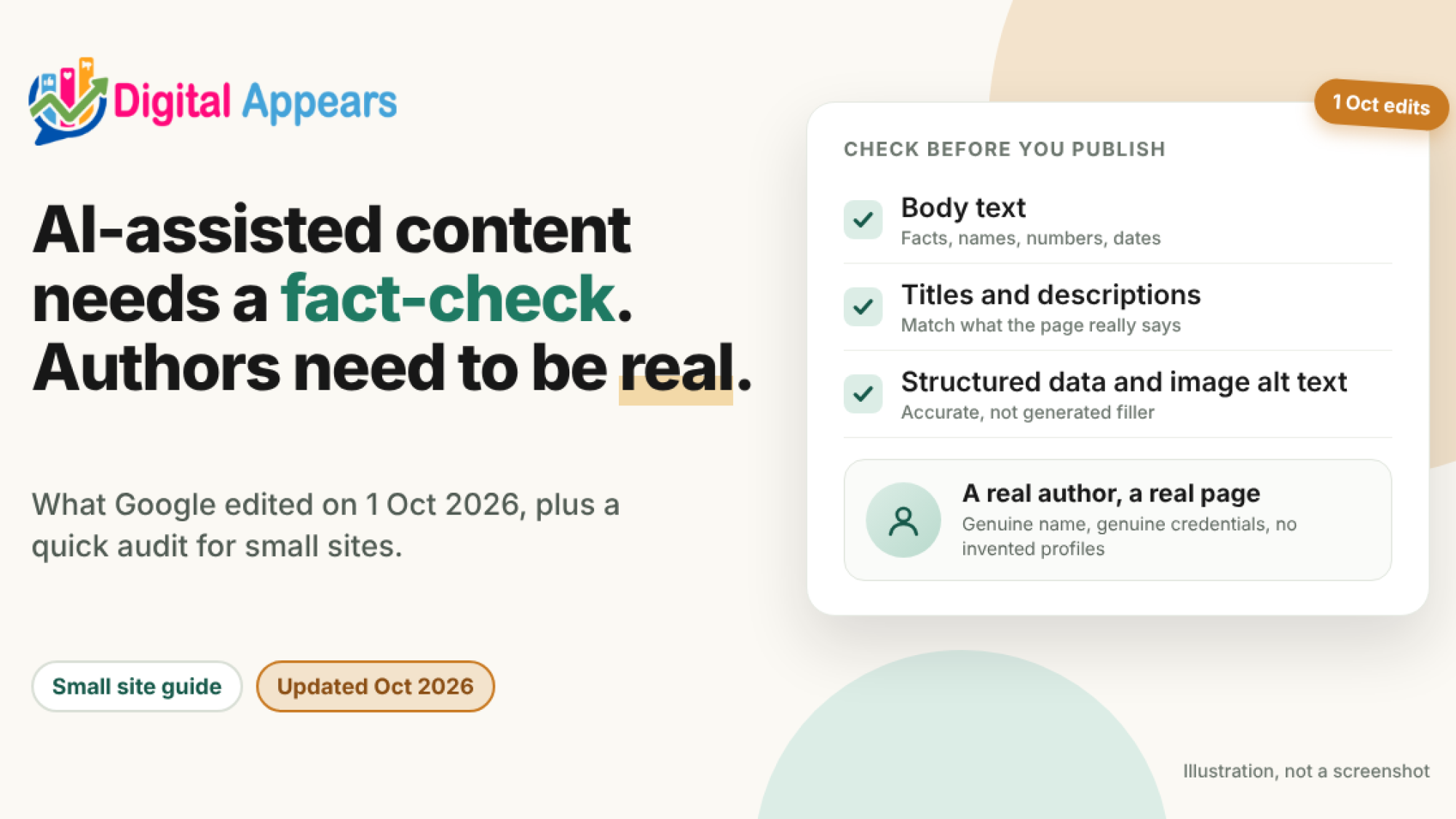
- On 1 October 2026 Google edited two of its guidance pages. One now says it's critical to manually fact-check and review all AI-generated content before you publish it. The other warns against fabricated author profiles.
- Both are documentation edits. Google announced no new ranking signal and no new penalty.
- The fact-check rule covers more than body text. Google names titles, meta descriptions, structured data and image alt text.
- Invented author names, AI-generated headshots and false credentials are now named as deception that makes a page untrustworthy.
- A small site can deal with both in about 30 minutes: review your AI-written pages and metadata, and check every author page and byline.
What Google changed
Google's Search Central documentation was edited on 1 October 2026. Search Engine Roundtable, Search Engine Journal and others reported three changes across two pages, and I confirmed the wording on Google's own pages on 29 October 2026. One of the pages shows it was updated again on 5 October.
| Date (2026) | Google page | What changed |
|---|---|---|
| 1 Oct | Guidance on using generative AI content | Added wording that models predict likely words rather than retrieve facts, so outputs can contain hallucinations, and that it is critical to manually fact-check and review all AI-generated content before publishing. The existing line about metadata was reworded so the review instruction applies to it. |
| 1 Oct | Creating helpful, reliable, people-first content | Added a definition of "main content" and described four attributes that quality raters assess: effort, originality, talent or skill, and accuracy. |
| Reported 1 to 6 Oct | Same helpful content page, in the "Who, How, Why" section | Added a warning against deceptive authorship information, including fabricated creator profiles with AI-generated headshots, made-up names or false credentials. |
According to the reports, Google said the AI-content edit was made to bring the page in line with the Search Quality Rater Guidelines and with presentations it gives at developer events. The helpful content page now shows a last-updated date of 5 October 2026, so it was edited again after these changes. I haven't been able to identify what changed on 5 October.
What did not change
- No new ranking signal. Google announced none, and no new manual action.
- No definition of "fact-check". Google does not say what counts as an adequate check, who should do it, or how to document it.
- Raters don't set rankings. The four attributes describe what Search Quality Raters are trained to assess. Google's own page says raters have no control over how pages rank and that rater data isn't used directly in its ranking algorithms.
- Scaled content abuse is unchanged. Google's page still says using generative AI to produce many pages without adding value for users may violate its spam policy on scaled content abuse.
Treat this as a clear statement of what Google expects, not a new penalty. Some commentators linked the edits to the September 2026 spam update. Google has not made that connection.
AI content: what "fact-check" covers
Google's wording is about all AI-generated content, not only blog posts. The reworded metadata line names four things that can appear in search results: title elements, meta descriptions, structured data, and alt text for images. Those are the places where AI is often used in bulk with the least checking.
Google doesn't say how to check. The table below is my own suggestion, based on where AI most often goes wrong.
| Content | Typical AI mistakes | What to check |
|---|---|---|
| Blog posts and guides | Invented statistics, wrong dates, quotes with no source, out-of-date advice | Every number, date and claim against its original source |
| Service and product pages | Features, prices, warranties or locations you don't offer | Every claim against what you really sell and do |
| Meta titles and descriptions | Promises the page doesn't keep, wrong location or service | That each one matches the page it describes |
| Structured data | Wrong prices, ratings, hours or addresses | That every value matches the visible page |
| Image alt text | Describes something that isn't in the image | A person looks at the image and the text together |
| Translations | Wrong terms, tone or meaning | A fluent reader reviews high-value pages |
A practical workflow for a small team: list the claims on each page, check them against sources, change anything you can't confirm, and keep a short log of who reviewed what and when. Google doesn't require a log. It just makes the check real and repeatable.
Author profiles: what counts as fake
The new paragraph says to avoid deceptive authorship information. It gives examples: fabricating creator profiles with AI-generated headshots, made-up names, or false credentials meant to make content look as if human experts wrote it. Google calls that deception and says it makes a page untrustworthy. As reported, it also treats it as a sign of a low-quality page, both for users and for its automated quality systems.
Likely a problem (my reading)
A made-up "senior editor" with an AI portrait. A credential, such as a degree or certification, that the person doesn't hold. A real expert's name attached to words they didn't write or review.
Likely fine (my reading)
A real person's real name, photo and honest bio. A plain team or company byline. A named reviewer who really checked the page.
Three points keep this in proportion. First, Google's page still "strongly encourages" accurate authorship information, such as bylines, where readers might expect it. Second, the guidance doesn't explain how its automated systems would spot a fabricated profile. Third, Google's Search Liaison said in January 2024 that bylines don't help pages rank better, as Search Engine Journal notes. So the point isn't to add more author boxes. It's to make sure the ones you have are true.
Main content and the four quality attributes
Google now defines main content as any part of the page that directly helps it achieve its purpose. That includes the primary text and media, tools and calculators, user contributions such as reviews and forums, tabbed sections, and page titles and headings.
It also describes four attributes that raters assess:
- Effort: how much human work went into the content or the systems behind it. Google's example of little to no effort is using generative AI to produce large amounts of text without manual oversight or curation. Crediting other sources does not replace original effort.
- Originality: unique information or perspectives not found elsewhere.
- Talent or skill: the expertise needed for a satisfying experience.
- Accuracy: factually correct, and highly accurate for health, money and other high-stakes topics.
For a small site, the easiest way to show effort and originality is first-hand material: your own photos, your own test results, local details, prices you actually charge, and answers to questions customers really ask. Generic text that could sit on any competitor's site is the weak point. For more on how this fits with AI answers, see how to optimize content for Google AI Overviews.
Should you tell readers you used AI?
Google's guidance doesn't make disclosure mandatory for ordinary pages, but it does encourage it. Its "How" question asks whether the use of automation, including AI, is clear to visitors and whether you explain how and why it was used. Google says disclosures are most useful where someone might reasonably wonder how the content was created.
A short, honest line is enough, for example: "Drafted with AI assistance and reviewed by [name] against the sources listed below." Only write it if it's true.
E-commerce sites have extra rules. Google's page says Google Merchant Center has policies for AI-generated content. AI-generated images must carry IPTC DigitalSourceType "TrainedAlgorithmicMedia" metadata, and AI-generated product titles and descriptions must be specified separately and labeled as AI-generated. If you run a Shopify or other online store, check your Merchant Center feed against this.
A 30-minute audit for small sites
Google gives no steps, so this is my own judgment, built from the changes above.
List your AI-assisted pages
Open a sheet with three columns: URL, what AI helped with (body, titles, descriptions, alt text, schema), and reviewed (yes or no). Start with the pages that bring in leads or sales.
Check the facts on your top 10 pages
Verify the numbers, dates, prices, claims and names against a source you can name. Fix or delete anything you can't confirm.
Read your metadata as a visitor would
Does each title and meta description match what the page says? Remove promises the page doesn't keep.
Check structured data against the page
The prices, ratings, hours, addresses and names in your markup should match what a visitor sees. Remove values you can't support.
Look at your alt text
Open a handful of images and read the alt text next to each one. Fix any that describe something that isn't there.
Audit every author page and byline
For each named author, confirm the person is real, the photo is theirs and every credential is true. Replace anything invented with a real person or an honest team byline.
Add something only you can add
Pick your three most generic pages and add first-hand material: photos you took, a real example, a local detail, or a price you actually charge.
Online stores: check Merchant Center labels
If you use AI for product titles, descriptions or images, confirm they're labeled and tagged the way Google's Merchant Center policies require.
What not to do
- Don't delete everything AI-assisted. Google asks you to review it, not remove it.
- Don't invent or inflate credentials. It's the exact example Google now gives.
- Don't swap a fake author for another fake author. Use a real person or an honest team byline.
- Don't bulk-generate again without a review step. Scaled content abuse remains a separate spam policy.
- Don't treat these edits as a penalty or a ranking update. Google has announced neither.
Read Google's pages yourself. We checked both on 29 October 2026, and they can change again. Their last-updated dates were 1 October and 5 October. Open Google's own guidance on generative AI content and its helpful content guidance, and check the dates before you act.
FAQ
Did Google change its AI content guidance in October 2026?
According to reports based on Google's Search Central changelog, yes. On 1 October 2026 Google added wording that it's critical to manually fact-check and review all AI-generated content before publishing. It also reworded its metadata line so the review applies to titles, meta descriptions, structured data and alt text.
Does Google ban AI-written content?
No. Google's page says generative AI can be useful for researching a topic and adding structure to original content. Using it to generate many pages without adding value for users may violate Google's spam policy on scaled content abuse. The October edits ask you to review AI-generated content for accuracy.
Is this a new ranking factor or penalty?
No. Google announced neither. It is a documentation change. Some commentators linked it to the September 2026 spam update, but Google has not.
What counts as a fake author profile?
Google's example is fabricating creator profiles using AI-generated headshots, made-up names or false credentials, so content looks as if human experts wrote it. A real person with an honest bio, or a plain team byline, is a different thing.
Do I need an author byline to rank?
Google's page strongly encourages accurate bylines where readers might expect them, but Google's Search Liaison said in January 2024 that bylines don't help pages rank better. The new guidance is about not being deceptive when you do show authorship.
Does the fact-check rule apply to meta descriptions and alt text?
Yes, according to the reported wording. Google names title elements, meta descriptions, structured data and image alt text as metadata that can appear in search results.
How do I prove I fact-checked my content?
Google doesn't say how. A simple record helps your own team: the page, who reviewed it, the date, and the sources used. It is a good habit, not a Google requirement.
Want a second pair of eyes on your content?
We can review your AI-assisted pages, metadata and author pages, and tell you what needs fixing and what doesn't. See our SEO services.
Ask for a content reviewSources
- Google Search Central: Guidance on generative AI content (last updated 1 Oct 2026, read 29 Oct 2026)
- Google Search Central: Creating helpful, reliable, people-first content (last updated 5 Oct 2026, read 29 Oct 2026)
- Search Engine Roundtable: Google: Manually Factcheck & Review AI-Generated Content For Accuracy (1 Oct 2026, Barry Schwartz)
- Relevant Audience: Google now calls manual fact-checking of AI content critical, including titles, schema and alt text (2 Oct 2026)
- Search Engine Roundtable: Google Warns Against Deceptive Authorship Information Within Content (6 Oct 2026, Barry Schwartz)
- Search Engine Journal: Google's fake author warning and site owner guidance (2 Oct 2026, Matt G. Southern)
- Relevant Audience: Google adds main content, effort and originality criteria and a fake author warning to its helpful content guidance
- PPC Land: Google says fake author profiles signal a low quality page
Related reading