
If you’re still writing three-paragraph intros before you get to the point, you’re already losing. Google’s AI Overviews pull direct, well-sourced answers straight to the top of the results page, and the pages that get quoted inside those boxes pull in noticeably more clicks than the ones sitting just below them, unquoted.
I’ve spent the last few months pulling apart why some pages get cited and others don’t, and it keeps coming back to three things:
- Answer first, context later. Every section should open with a straight 40-80 word answer before you get into the backstory.
- Say something the internet doesn’t already know. Original data, real quotes from real people, numbers with a source attached.
- Make sure a machine can actually read your page. Proper schema, fast HTML, nothing hidden behind JavaScript a bot won’t wait around for.
The rest of this post covers the how: the actual editorial and technical changes I’ve made on client sites to get this right.
New to the term? What Is GEO (Generative Engine Optimization)? is a good place to start before this gets more tactical.
How Google AI Overviews Actually Pick Their Sources
AI Overviews run on models like Gemini, using retrieval methods such as RAG, dense passage retrieval, and vector similarity to pull relevant chunks of text from across the web and stitch together an answer with citations attached. The key word there is “chunks.” Google isn’t reading your page top to bottom the way a person would.
For Google’s own account of how this works and what’s required to be eligible, its AI features and your website guidance is worth reading directly. The short version: your page has to meet the normal technical requirements to be indexed and shown with a snippet in regular Search. There’s no separate, additional bar to clear for AI Overviews specifically. Everything below is about clearing that bar well, not about some hidden AI-only checklist.
Why a Good Paragraph Beats a Long Page
Here’s the part most people get wrong. Your page doesn’t get evaluated as one piece. It gets sliced into passages, usually somewhere around 75-225 words, and each one is scored on its own. That means a single sharp paragraph buried on page three of your article can get pulled and cited, while a beautifully written but rambling 400-word section gets skipped entirely because there’s no clean chunk to lift.
A few things follow from that:
- Stick to one idea per paragraph, and open with the topic sentence, not the runway.
- Break up dense explanations instead of trying to say everything in one block.
- Ask yourself, for every H2 and H3: could this section survive on its own, cut out and pasted somewhere else, and still make sense?
We go deeper on this in the Advanced On-Page SEO Checklist 2026, if you want the full structural breakdown.
What Query Fan-Out Means for What “Ranking” Even Is
Google doesn’t just match your page against the exact phrase someone typed anymore. For AI Overviews and AI Mode, Gemini breaks a single query into a batch of related sub-queries, evaluates search results for each one, then weaves the strongest passages together into a single answer. This is called query fan-out, and it’s arguably the biggest reason ranking #1 for your target keyword no longer guarantees a citation.
In practice, a search for “best running shoes for flat feet” might quietly fan out into sub-queries about arch support, pronation, specific shoe models, and injury prevention. Your page can win a citation by dominating one of those sub-queries even if it never ranks for the headline term. Ahrefs has a detailed breakdown of the mechanism in What Is Query Fan-Out? if you want to go further into how it works.
The practical takeaway: stop optimizing a page around one keyword and start building it to answer the full cluster of questions a real searcher, or a fanned-out AI query, would actually ask around that topic. This is the same logic behind Building Topical Authority with Content Clusters, where we map coverage across a whole topic rather than one page at a time.
Ranking #1 Isn’t the Requirement It Used to Be
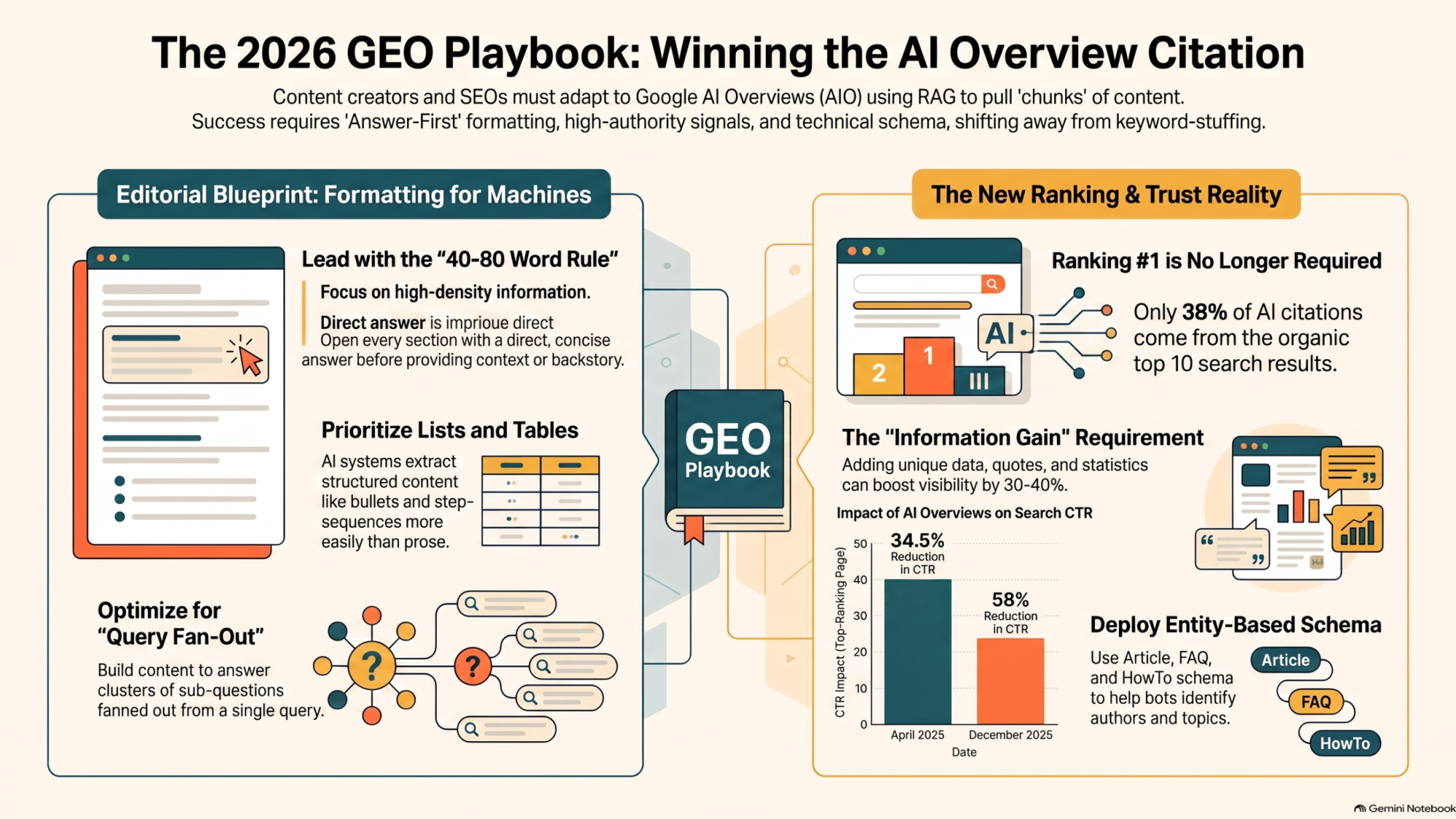
This one surprised me too, and the data on it has moved fast even in the past year. Ahrefs’ original 2025 analysis of 1.9 million citations found that 76% of AI Overview-cited pages also ranked in the organic top 10 for the same query. By March 2026, a much larger follow-up study covering 863,000 keyword SERPs and 4 million AI Overview URLs found that number had fallen to just 38%, with a nearly even split between citations from positions 11-100 and citations from pages that don’t rank in the top 100 at all (Ahrefs, “Update: 38% of AI Overview Citations Pull From Top 10 Pages”).
Part of that drop is Ahrefs refining how it detects citations, and part of it reflects real behavioral change tied to query fan-out and the January 2026 shift to Gemini 3 as the default AI Overviews model. Either way, the direction is consistent: Domain Rating and top-10 position matter less than they used to; topical relevance and information gain matter more.
Practically, this means:
- You don’t need to out-rank everyone to get cited. You need to be the most useful, specific answer to the actual question, or to one of its fanned-out sub-questions.
- Consistent brand and entity signals (same author name everywhere, sameAs links, mentions in other people’s content) push you toward being the “trusted” pick.
- Don’t expect stability. Google swaps out cited sources for the same query often enough that you should treat this as an ongoing job, not a one-time fix.
- Video is a bigger factor than most GEO advice accounts for. In that same Ahrefs dataset, YouTube URLs made up over 18% of citations that didn’t rank organically in the top 100, and YouTube has grown its overall AI Overview citation share by roughly a third in six months. If your topic supports it, a video asset is now a legitimate part of a GEO strategy, not an afterthought.
Write the Answer Before You Write the Article
If there’s one change that moves the needle more than anything else here, it’s this: put the direct answer in the first sentence or two of every section, before any of the throat-clearing. AI systems are built to lift clean, self-contained answers, so give them one.
The 40-Word Rule
For any heading that’s really asking a question (and most of them are, whether you phrased it that way or not), the paragraph right underneath should do three things:
- Answer it directly: a definition, a recommendation, a fact.
- Back it up with the single most important detail, ideally a number or a source.
- Tell the reader why it matters or what to do about it.
Something like:
To optimize content for Google AI Overviews in 2026, lead every section with a 40-80 word direct answer, then support it with data and examples. Pages using answer-first formatting plus sourced statistics see up to 40% higher AI citation visibility in controlled tests. Start by rewriting your top 10 pages’ opening paragraphs to follow this pattern.
Cut lines like “In this article, we’ll explore…” entirely. They cost you the one thing you can’t get back: the reader’s (and the AI’s) attention in the first sentence.
You’ll see this pattern across our own SEO Services page too. We don’t just tell clients to do this, we do it ourselves.
Lists and Tables Get Picked Over Paragraphs
AI systems have an easier time lifting structured content, and the data backs that up. Lists, tables, and clear step sequences get cited more often than dense prose saying the same thing.
- Ordered lists for anything procedural.
- Bullets for features, benefits, checklists.
- Simple tables when you’re comparing options or laying out thresholds.
- Keep each item to a sentence or two. Don’t let list items become paragraphs in disguise.
If a section is basically a “how to” or “best practices” list dressed up as prose, just make it a list. It’s a small edit that meaningfully raises your odds of being the one quoted.
Our Technical SEO Audit Checklist is a decent example of this in practice.
Write Headings Like Someone Would Actually Ask Them
Skip “Technical Considerations.” Nobody asks a search engine that. Try:
- “What Technical Factors Prevent Content from Appearing in AI Overviews?”
- “How Often Should You Refresh Content for AI Search?”
- “Which Schema Types Help AI Systems Extract Answers?”
This does two things at once. It makes the implicit question obvious to the reader, and it lines your headings up with how AI systems actually parse multi-part, follow-up-style queries. While you’re at it, cut the hedging. Words like “might,” “could,” and “possibly” don’t make you sound careful, they make you sound unsure, and both readers and ranking systems read that as lower confidence.
More on this in our Content Strategy for AI Search framework.
Say Something New, or Don’t Expect to Get Cited
AI summarizers are pretty good at spotting content that’s just repeating what’s already out there. If your page reads like everyone else’s page on the same topic, there’s no reason to cite yours specifically.
Use Your Own Data
This isn’t just a hunch. The Generative Engine Optimization research out of Princeton and Georgia Tech, the paper that gave GEO its name, ran a large benchmark of AI-generated responses and tested specific content changes against it. Adding cited sources, statistics, and quotations were among the strongest levers tested, each improving content visibility by roughly 30-40% on their own, with combinations of tactics performing even better (Aggarwal et al., “GEO: Generative Engine Optimization,” arXiv). It’s one of the few claims in this space with an actual controlled study behind it, rather than just vendor-reported correlation, which is why it’s worth linking to directly if you’re citing it yourself.
A few ways to actually apply it:
- Cite specific, dated numbers. “In a March 2026 analysis of 12,000 queries, cited pages had 62% more factual statements than non-cited pages” is a lot more useful than “studies show.”
- Pull from your own work: internal benchmarks, client results, survey data.
- Quote a real person with a real title. “According to Shishir Goel, Founder of Digital Appears…” carries more weight than an unattributed claim.
Before you publish, go through and check: does each major claim have a number or a name attached to it? If not, either find one or cut the claim.
We do this openly in our SEO Case Studies section: before-and-after numbers, actual timeframes, nothing hand-wavy.
Show Your Work, Not Just Your Opinion
AI systems weigh experience-based trust signals heavily, and that’s not really new. It’s the same E-E-A-T logic search has leaned on for years, just applied more literally now.
- Author bios that actually say who wrote this and why they’re qualified.
- Real examples from real projects. “In a 2025 e-commerce project, we increased AI-cited pages by 2.3x after implementing answer-first formatting” beats a generic claim every time.
- Schema that connects your author to a real, verifiable identity (Person, Organization, sameAs links to LinkedIn and similar).
- Results with scope attached: sample size, timeframe, what actually changed. “12-site sample over 6 months” reads as evidence. “We saw great results” reads as marketing copy.
Our About Shishir Goel page lays this out: 14+ years in SEO, with the outcomes to back it up.
The Technical Side: Making Sure AI Can Actually Read You
None of the above matters if a crawler can’t get to your content in the first place. This is the less exciting half of GEO, but it’s where a lot of otherwise-good content quietly fails.
Schema: Article, FAQ, HowTo
Schema is how you tell an AI system, explicitly, what your page is and how it’s put together.
- Article / BlogPosting: headline, author, datePublished, main entity.
- FAQPage: actual question-and-answer pairs.
- HowTo: step-by-step guides broken into HowToStep items.
Two properties worth paying extra attention to are about and mentions, which tie your content to specific entities (topics, tools, brands), and sameAs on Person and Organization schema, which links your identity to something verifiable like LinkedIn, Crunchbase, or your own site.
Here’s a simplified example:
“`json { “@context”: “https://schema.org“, “@type”: “Article”, “headline”: “How to Optimize Content for Google AI Overviews in 2026”, “author”: { “@type”: “Person”, “name”: “Shishir Goel”, “sameAs”: [ “https://www.linkedin.com/in/yourprofile“, “https://digitalappears.com/about/” ] }, “about”: [ { “@type”: “Thing”, “name”: “Generative Engine Optimization” }, { “@type”: “Thing”, “name”: “Google AI Overviews” } ], “mentions”: [ { “@type”: “Thing”, “name”: “Gemini” } ] } “`
It won’t get you cited on its own, but it removes friction that might otherwise cost you the citation.
We cover the full setup on our Technical SEO Services page.
Don’t Make a Bot Wait
If your key content only shows up after a pile of JavaScript finishes running, or it’s tucked behind an interactive widget with no fallback, plenty of AI crawlers will just miss it.
- Make sure the important answers and data are in the HTML that loads first: server-side rendering or static generation, not client-side only.
- Keep Time to First Byte and LCP tight; cut anything that blocks rendering unnecessarily.
- Don’t put your best content behind a login wall or an aggressive pop-up that a bot can’t get past.
- Actually check your robots.txt and WAF/CDN rules. It’s surprisingly common to be accidentally blocking OAI-SearchBot, PerplexityBot, or Google-Extended without realizing it.
We go into more depth on this in Core Web Vitals & Performance SEO.
Keep It Fresh, and Actually Track Whether It’s Working
Publishing once and walking away doesn’t work anymore. AI Overviews favor recent, accurate information, and citations shift more than people expect.
Update on a Schedule
Set up a quarterly pass on your important pages:
- Update numbers, tool versions, and anything year-specific (yes, change “2025” to “2026”).
- Check your outbound links still go somewhere real and current.
- Add new data or examples where you can. Freshness compounds.
- Put a visible date stamp on the page (“Updated: August 2026”) and reference recent events or studies where relevant.
This is the same idea behind our Content Refresh & Pruning Strategy.
Watch AI Visibility, Not Just CTR
Regular rankings and click-through rate don’t tell you the whole story anymore. You need to know whether you’re actually showing up inside the Overview itself.
- Tools like SEMrush AI Toolkit, Ahrefs Brand Radar, or Indexly can track AI Overview appearances and, where possible, citation position.
- Line up traffic changes against known AI Overview rollout dates for your query set.
- Track how often your brand shows up in AI answers, even manually, as a rough proxy for citation share.
A workflow that actually works:
- Pick your top 20 target queries.
- Check the AI Overview for each one, monthly, and note who’s cited.
- Log when you appear, what snippet gets used, and what you changed right before it happened: a refresh, new schema, new data, whatever it was.
Citations for the same query can shift week to week, so track the pattern over time, not just a single snapshot.
More on measurement in our SEO Reporting & Analytics service page.
What Kills Your Chances of Being Cited
A few things I see constantly that quietly disqualify otherwise decent content:
- The answer is buried three paragraphs deep, or only shows up near the bottom of the page.
- Hedgy, uncertain language (“might,” “could,” “possibly”) everywhere.
- An intro that sets the scene instead of answering anything.
- Statements that contradict each other, or contradict what’s widely accepted elsewhere.
- Content locked behind a paywall, login, or an interstitial aggressive enough to block a bot.
We check for exactly this in our SEO Content Audit work, alongside the usual technical checks.
Questions People Actually Ask About AI Overviews
Can a page that doesn’t rank still show up in an AI Overview?
Yes, and it happens more than you’d think. Ahrefs’ March 2026 study found roughly six in ten AI Overview citations now come from pages outside the organic top 10, including a large share that don’t rank in the top 100 at all (Ahrefs).
Does adding schema guarantee I’ll get cited?
No. Schema helps a machine understand and extract your content more reliably, but it’s not a golden ticket. The content itself, how specific it is, whether it says anything new, how trustworthy the source looks, still does most of the work. Google’s own guidance confirms there are no extra technical requirements beyond standard Search eligibility (Google Search Central).
What do AI Overviews do to click-through rates?
More than most people realize, and the number has moved fast. Ahrefs’ original April 2025 study of 300,000 keywords found AI Overviews cut the top-ranking page’s click-through rate by about 34.5% compared to similar queries without one (Ahrefs). When Ahrefs re-ran the same analysis on December 2025 data, the gap had widened to roughly 58% (Ahrefs update). Being cited inside the Overview doesn’t erase that loss, but it’s currently the best lever available for recovering some of that traffic.
What the Competition Is Doing (and Where the Gaps Are)
| Competitor | Core Content Format | Key Ranking & Traffic Strategies | Primary Weakness / Opportunity Gap |
| Conductor | 10-step procedural guide focused on enterprise workflow and tool integration. | Question-based H2/H3 headers; inverted pyramid answering; high internal linking across semantic clusters. | Highly self-promotional toward their enterprise tool; lacks specific schema code examples and hands-on JSON-LD snippets. |
| SE Ranking | Data-driven blog post citing their own research on AI Overview behavior. | Proprietary stats (e.g., “AIO-cited pages have 62% more factual statements”); clear visual callouts and listicles. | Strong on research but lighter on step-by-step editorial workflows and answer-first rewriting examples for content teams. |
| The HOTH | Practical listicle (“7 Best Practices”) targeting mid-market SEOs and agencies. | Immediate definitions under main queries; “Common Mistakes to Avoid” section; high-level readability score. | Generic advice; lacks deep technical schema guidance, multi-hop query analysis, and entity-focused optimization. |
| Google Search Central / Developers | Official documentation & blog post (“Succeeding in AI Search”). | Ultimate baseline authority; clear policy guidelines on crawlability and preview controls. | Deliberately broad and philosophical (“focus on people-first content”); no actionable copywriting blueprints or formatting templates. |
The gap, as I see it: SE Ranking has the data, Conductor has the structure, and nobody’s really combining the two with hands-on, copy-paste schema templates and real case studies attached. That’s the angle worth taking: concrete rewrites, templates built for markets like India and the UK specifically, and outcomes from actual client work rather than theoretical best practices.
This is roughly how we approach SEO Strategy & Consulting projects for clients across India, the UK, and elsewhere.
External Resources Worth Bookmarking
If you want to dig into the primary sources behind the data in this guide, these are the ones worth reading directly rather than taking secondhand:
- Google Search Central: AI features and your website, Google’s own guidance on eligibility and best practices.
- GEO: Generative Engine Optimization (arXiv), the original academic paper behind the visibility-boost statistics cited throughout this piece.
- Ahrefs: Update, 38% of AI Overview Citations Pull From Top 10 Pages, the current data on how much AI citations have diverged from organic rankings.
- Ahrefs: What Is Query Fan-Out?, a deeper technical explanation of how AI search expands a single query into many.
- Ahrefs: AI Overviews Reduce Clicks (Update), the latest CTR-impact data referenced in the FAQ above.
Keep Reading
This post anchors our AI Search & GEO content cluster. If you want to go deeper on any one piece:
- What Is GEO (Generative Engine Optimization)?
- Answer-First Content Writing Guide
- Technical SEO Audit Checklist
- Building Topical Authority with Content Clusters
- Content Refresh & Pruning Strategy
- AI Search & CTR Trends 2026
Add a Comment