
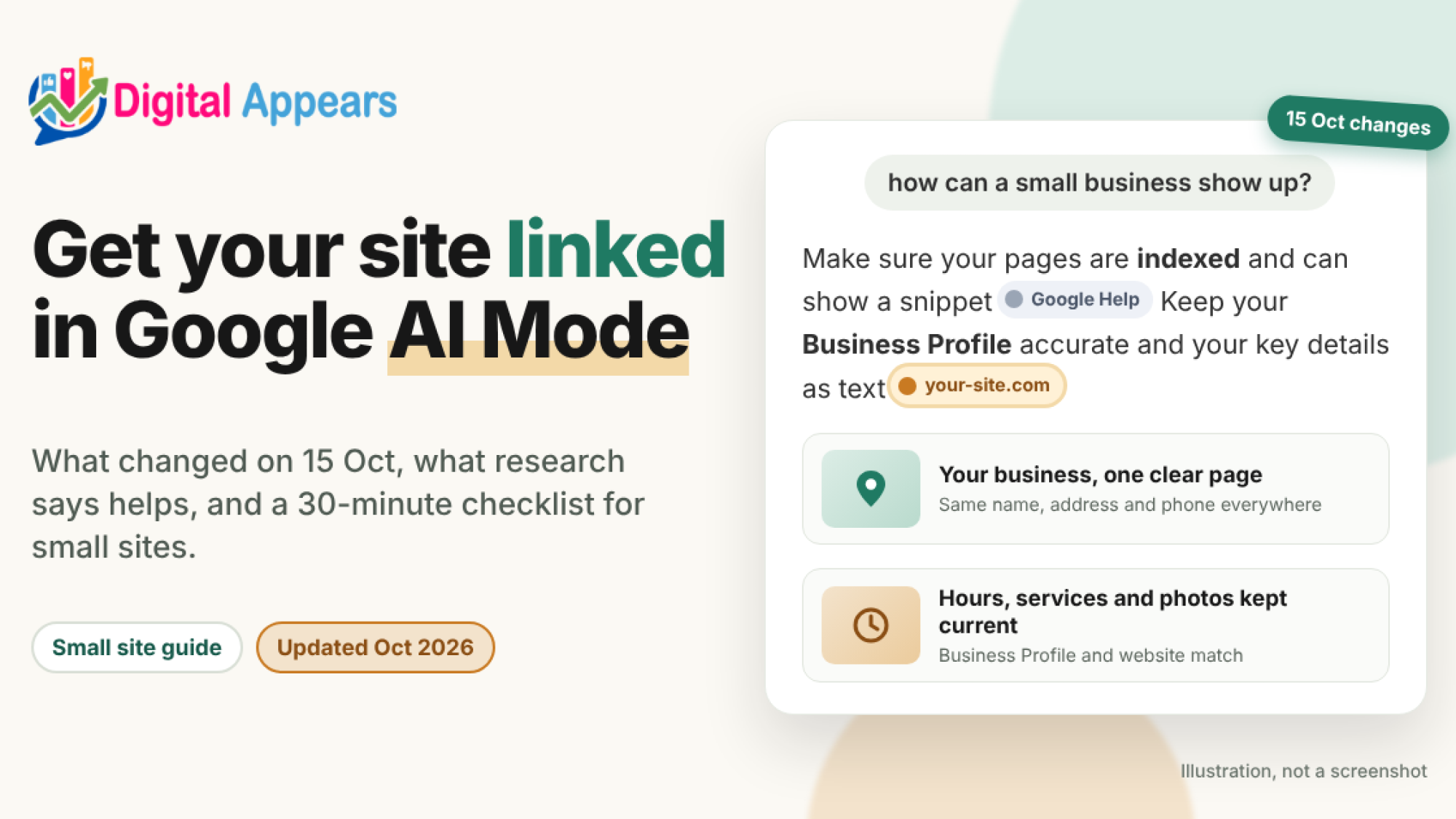
Last updated: 27 October 2026 · Based on Google's announcement, published research and our own test
- On 15 October 2026 Google announced five link changes in AI Mode and AI Overviews. Two are tests, and Google gave no click data.
- Google says a page needs to be indexed and eligible to show with a snippet. It says there are no additional requirements and no special markup.
- Research finds no universal formula for being cited. In one large test, adding schema did not move AI Mode citations.
- For local businesses, an accurate Google Business Profile looks like the bigger lever. In my test, local answers were built from profile data.
- Measure with Search Console's generative AI report (impressions only), plus GA4 and Business Profile insights.
What Google changed on 15 October
On 15 October 2026, Google published a post called "More ways to connect with the web from Search". It describes five changes to links in AI Mode and AI Overviews. Search Engine Journal, 9to5Google and others reported the same list. Some of it is live, some is only a test, and Google left out most of the detail.
| Change | Status | What Google did not say |
|---|---|---|
| Inline links shown higher in responses, more often | Launching | How many more, on which queries, in which countries |
| A section at the top of a response for the one or two "official" places to complete a task, with a note on why each link helps | Test | Start date, markets, query types |
| Carousels of timely articles, which also highlight a user's Preferred Sources, in more locations and languages | Rolling out | Which locations and languages |
| Image thumbnails and a more clickable design for links at the end of some responses | Design change | Timing and scope |
| Clickable creator and publisher names on video results in AI Mode, linking to Search profiles | Test, started the week of 12 Oct | Markets, plans to expand |
Google also said the number of people using Preferred Sources has grown more than sevenfold since the start of 2026. It gave no starting number, so there's no way to size that growth.
What's missing. The announcement has no click-through data, no figures on how often each placement appears, and no guidance for site owners. Whether these changes send more visits to small sites isn't known. This is also a different update from Google's 6 May 2026 post on subscription labels and hover previews.
What Google says your site needs
Google's page "AI features and your website" is short on this point. A page needs to be indexed and eligible to appear in Search with a snippet. Google says there are no additional technical requirements, no special markup, no special structured data and no AI-specific files.
The same page says the usual fundamentals still apply:
- Let Google crawl your pages, including through any CDN or host settings.
- Make content easy to find with internal links.
- Give people a good page experience.
- Keep important content as text.
- Support text with relevant images and video.
- Keep structured data consistent with what is visible on the page.
- Keep Business Profile and Merchant Center information current.
It also says clicks from AI Overviews and AI Mode count in your normal Search Console Performance report under the Web search type.
Check the date. When I read this page on 27 October 2026, it showed a last-updated date of 10 December 2025. That's before the October changes, so it tells you nothing about them. Re-read it before you rely on it.
What research says helps (and what it can't prove)
There's no published ranking formula for AI Mode citations. A review by the Search Institute pulled together ten studies available up to 26 August 2026. It warns that the studies use different samples and can't be compared directly. Most are from vendors, so treat them as observations, not audits.
| Finding | Source | What to do with it |
|---|---|---|
| Sites with strong overall search visibility were cited more often | Semrush data, via the Search Institute review | Basic SEO and authority still matter. There is no shortcut. |
| Cited pages more often carried structured data (Organization markup on 34%, Article on 26%) | Semrush, 5 million cited URLs, via the review | This is correlation only. Better-run sites tend to have more markup. |
| Adding JSON-LD to 1,885 pages, compared with 4,000 pages that did not change, moved AI Mode citations by 2.4%. The authors call that "statistically indistinguishable from zero" | Ahrefs, May 2026, via the review | Don't add schema just to get cited. Add it for consistency and rich results. |
| google.com was the most cited source in AI Mode at 17.42% of citations. Business Profiles made up 36.1% of those Google citations | SE Ranking (68,313 keywords, 1.3 million citations), via Search Engine Land | For local searches, your profile matters. The study shows no date or keyword selection, so hold it loosely. |
Here's my honest summary: strong sites get cited more, schema alone didn't change much, and nobody outside Google knows the weights. Anyone selling a guaranteed AI citation is guessing.
What we saw in AI Mode
On 27 October 2026 I ran 11 searches in AI Mode: local service queries, brand queries, how-to questions and one "official website" query. I used a signed-in account in India and mostly turned personalization off. This is a one-day snapshot of 11 searches, so read it as an illustration, not a study.
- Local answers were built from Business Profile data. Searches like "SEO agency in Ghaziabad" returned cards with rating, review count, opening status and Call, Directions and Website buttons. Every business shown in the three local-service searches was a Business Profile listing.
- I didn't show up myself. My own Business Profile is verified but has no reviews yet, and I was missing from two local "SEO agency" searches. I can't say that's the cause, because a business with only a handful of reviews was listed in one of them.
- A business with no website can appear. One local shop with no website at all showed up in a local search, using its profile and its Facebook page.
- Brand answers repeat what your own pages and profiles say. My brand searches returned the address, phone and email from my site's contact page, and a bio drawn from third-party profiles. Whatever you publish about your business is what gets repeated.
- How-to answers leaned on Google Help, Reddit, YouTube and agency blogs. In the two how-to searches I ran, none of my own pages were cited.
- AI Mode got a fact about Google wrong. One answer said Search Console's generative AI report shows clicks. Google's announcement and independent write-ups say it shows impressions only. Check Google's own pages for anything that matters.
From the 15 October list, I saw inline source links beside sentences and thumbnails in some source cards. I didn't see the official-sites section above an answer, news carousels or clickable video creator names, though I didn't run any news or video searches. I also have no view from before 15 October, so I can't say any of this is new.
On my own site, Search Console's generative AI report shows 21 impressions between 10 and 24 October, and none before 10 October. That's too small to draw any conclusion, and the report shows no clicks, so I don't know whether anyone visited.
A 30-minute checklist for small sites
Google gives no steps for the October changes, so this checklist is my own judgment, built from Google's fundamentals and the research above.
Check that key pages are indexed and can show a snippet
Use URL Inspection in Search Console on your top pages. Make sure none carry a nosnippet tag or a very low max-snippet value, since Google says a page must be snippet-eligible.
Keep key content as text
If important details live only in images or load only through scripts, they may be missed. See our JavaScript SEO checklist.
Give each task one clear official page
Have one page for contact, one for booking or enquiries, and one for each main service. Use the same business name, address, phone and hours everywhere. Google's official-sites section is only a test, but a clear destination helps either way.
Check the image on your top pages
Links at the end of some responses now get thumbnails, so make sure your featured and social sharing images on key pages are clear and relevant.
Keep your Business Profile current
Check categories, hours, phone, services, photos and reviews. If you sell products, keep your Merchant Center details current too. Google lists both on its own AI features page.
Keep structured data honest
Make sure your markup matches the visible page. Add it for consistency and rich results, not as an AI trick.
Run your own AI Mode check each month
Search your brand name and your main service in AI Mode with personalization off. Screenshot what appears and where, then repeat it every month so you have a baseline.
Set up GA4 to see AI referrals
Follow our guide to tracking AI traffic in GA4, so you can see visits Search Console can't count.
If you are a local business
Local searches are where the Business Profile findings matter most. In my log, local answers read like a list of profiles with call and directions buttons, not a list of websites. The SE Ranking study points the same way, with Business Profiles making up a large share of Google's own citations.
- Make sure your profile is verified, and that the name, address, phone and hours match your website.
- Add real photos, and answer reviews.
- If you have no storefront, read our guide to ranking in Google Maps without a storefront.
- If you want help with the profile and local pages, see our local SEO services.
One caution: the profile listings in my test weren't simply the businesses with the most reviews. A business with only a handful of reviews was listed, so review count doesn't look like the only gate. I can't say what the real factors are.
How to measure it honestly
Search Console now has a Generative AI report. It's labelled Beta and Google is rolling it out to a subset of sites. It shows impressions from AI Overviews and AI Mode by page, country, device and date.
| What you want to know | Where to look | What it can tell you | Limit |
|---|---|---|---|
| Was my page shown in an AI answer? | Search Console, Generative AI report | Impressions by page, country, device, date | No clicks, no queries, no position |
| Did people visit from AI answers? | GA4 referrals, Search Console Performance (Web) | Visits, though AI traffic is mixed into normal search | Can't be separated cleanly in Search Console |
| Did my brand searches grow? | Search Console queries | Brand demand over time | Many causes, not only AI |
| Did my profile get calls and directions? | Business Profile insights, call tracking | Local actions | Not tied to a single AI feature |
Three reading rules. First, property totals count two URLs from your site in one response as one impression, so page rows may not add up to the total. Second, AI impressions aren't the same as normal search impressions, so don't add them together. Third, judge changes over weeks, not days. On my own site the page rows added up to 22 while the chart total was 21, which is that effect in practice.
For more on brand data, see AI Overviews on brand searches and how to optimize content for AI Overviews. And if your rank tracker shows a sudden drop, check Search Console first, as we explain in our rank tracker post.
What not to do
- Don't buy "AI visibility" packages that promise citations. No verified method exists, and Google's own page lists no special steps.
- Don't add schema only to get cited. One large test found no effect.
- Don't rewrite pages because of a test. The official-sites section and creator links are tests that may change or never spread.
- Don't use Search Console position to judge these changes. The Generative AI report does not show position, and AI Overviews have counted all their links as one position.
- Don't trust an AI answer about Google's tools without checking Google's page. I caught one that was wrong.
FAQ
Did Google change AI Mode links on 15 October 2026?
Yes. Google announced five changes: inline links higher and more often, a test of a top-of-response section for official sites, wider timely-article carousels, thumbnails on end-of-response links, and a test of clickable creator names on video results. Two of the five are tests.
How do I get my site linked in Google AI Mode?
Google says a page just needs to be indexed and eligible to show with a snippet. No extra requirements, no special markup.
Do I need special schema or an llms.txt file?
Google says no special markup or AI text files are needed. In one large test, adding schema to 1,885 pages did not measurably change AI Mode citations. Use structured data for consistency and rich results.
Will the new links send me more traffic?
Nobody knows yet. Google has not published click data for these changes, and we found no independent data for them either.
Can I see AI Mode clicks in Search Console?
Not separately. AI Mode clicks count in the Performance report under the Web search type, mixed with normal search. The Generative AI report shows impressions only, with no clicks, queries or position.
Does my Google Business Profile affect AI Mode?
Google tells site owners to keep Business Profile information current, and local answers in our test were built from profile data. We can't prove the profile causes a business to be shown, but keeping it accurate is low risk.
What is the official-sites section?
It is a test in which Google may show the one or two official links for a task at the top of an answer, with a note on why each is useful. Google gave no start date or markets, and we did not see it in our searches.
Not sure what your site shows in AI Mode?
We can run the checks above for your business, fix the basics, and set up reporting that separates what is known from what is guessed. See our SEO services.
Ask for an AI Mode checkSources
- Google: More ways to connect with the web from Search (15 Oct 2026)
- Google Search Central: AI features and your website
- Google Search Central Blog: Introducing Search Generative AI performance reports in Search Console (June 2026)
- Search Engine Journal: Google Puts Inline Links Higher In More AI Search Responses (15 Oct 2026)
- Search Engine Journal: Google Now Reports AI Search Impressions. Here's How To Read Them (4 Aug 2026)
- 9to5Google: Google AI Mode and AI Overviews links update (15 Oct 2026)
- PPC Land: Google pushes links higher in AI answers as Preferred Sources use rises 7x (18 Oct 2026)
- PPC Land: Google finally gives Search Console its own generative AI visibility reports
- Search Institute: What Makes a Website More Likely to Be Cited by Google AI Mode?
- Search Engine Land: Google's AI Mode is citing Google more than any other site: Study
Related reading