
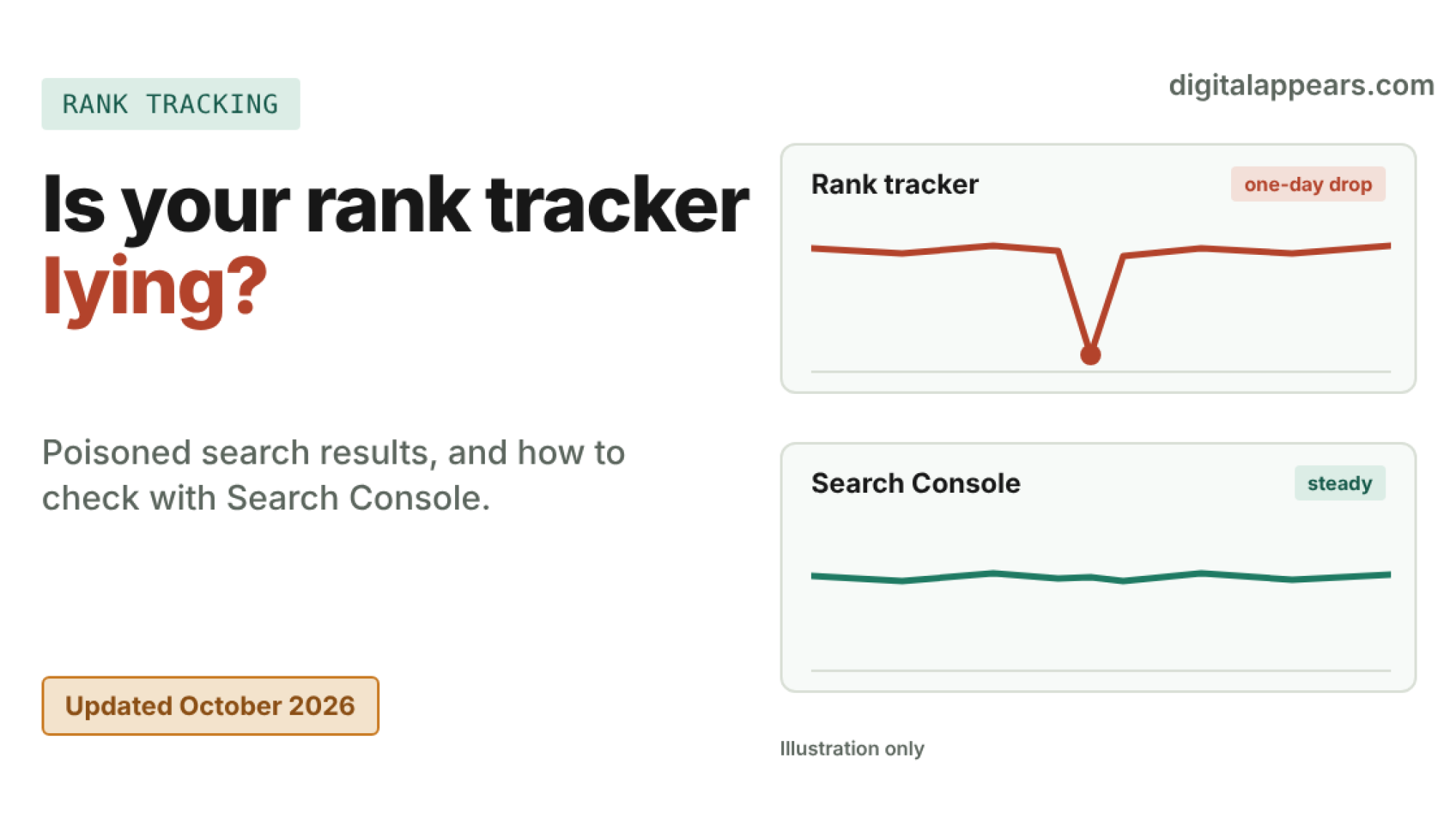
- Several SEO firms report that since September 2026 Google has sometimes returned wrong results to automated rank-tracking requests. A page looks normal, but many of a keyword's usual sites are missing.
- Nozzle, the firm behind the study, counted 8.0% of the search result pages it could judge between 13 September and 9 October as "poisoned". Other firms measured much lower rates, and in the reports I read Google hasn't commented.
- These bad checks mostly last one collection. A sudden one-day drop that reverses the next day is a classic sign.
- Before you panic or tell a client their rankings fell, check Search Console. If clicks, impressions and position held steady, the tracker is probably wrong.
- Not every drop is noise. Real changes happen too, so watch for a few days before you decide.
What is being reported
Rank trackers work by asking Google for search results, over and over, for the keywords you care about. According to a study from the enterprise rank-tracking firm Nozzle, since about 20 September Google has sometimes answered those automated requests with a complete, normal-looking page that holds the wrong results, instead of refusing the request.
The tracker can't tell the difference, so it stores the bad page as if it were real. In your dashboard it looks like a page you rank well for suddenly lost its position, or a competitor jumped up overnight. In reality, nothing may have changed.
What's confirmed and what isn't. The findings come from Nozzle and other firms, reported by outlets including Search Engine Journal and Search Engine Watch. In the reports I read, Google has made no public statement about it. Treat the causes below as reported or inferred, not confirmed.
| Date (2026) | What was reported |
|---|---|
| Before 13 Sept | Nozzle measures 0.17% of pages as "poisoned". |
| 20 Sept | The first poisoned pages appear in Nozzle's data. Across 13 Sept to 9 Oct, 8.0% of pages it could judge were poisoned. |
| 27 to 29 Sept | Nozzle's peak: between 24.9% and 27.0% of pages a day. |
| From 1 Oct | Roughly 5% to 11% of pages a day, according to Nozzle. |
| 12 Oct | Search Engine Roundtable reports Nozzle's study (data through 9 October). |
| 14 Oct | Search Engine Journal analyses the findings. |
| 15 Oct | Site owners report traffic and ranking swings every hour or two after the September spam update ended. One well-known SEO reporter called it an "unconfirmed update". AccuRanker reportedly said Google tightened its detection on this date, mostly on mobile. Google made no statement confirming this. |
| 19 Oct | Semrush says the impact on its users has been limited and mostly beyond page one. |
What the numbers say (and why they differ)
Nozzle defines a "usual" set of sites for each keyword: those that held a top-10 spot on at least 60% of its pages from 20 August to 9 September. A page counts as poisoned when fewer than half of those usual sites appear and they come back on a later collection. On that basis, Nozzle reports:
| Measure | Normal pages | Poisoned pages |
|---|---|---|
| Usual sites carried over from the last check | 88.5% | 20.7% |
| Tracked site missing from the top 10 | 2.7% | 58.6% |
| AI Overview shown | 54.2% | 34.9% |
| "People also search for" shown | 87.2% | 52.7% |
Nozzle also reports that 80% of poisoned results lasted a single collection, and that on 77.9% of affected pages the usual sites came back within three days (a median of two). Poisoned pages also showed more user-generated content, such as Reddit, Quora and Facebook, and fewer Yelp and YouTube results.
Other firms measured it differently. Semrush said the impact on its users has been limited. AccuRanker, according to Search Engine Watch, reported a peak of 30.2% of sampled desktop pages (25.7% on mobile) on 25 September, with both under 1% by 17 October. These tests aren't directly comparable, and none has been independently audited. Take them as a sign that the problem is real and uneven, not as a number to apply to your own data.
If you track brand searches, this also touches AI answers: poisoned pages showed AI Overviews less often in Nozzle's data, so a missing AI Overview in your tracker may be a clue. See our post on AI Overviews on brand searches for how to read that data.
Signs your tracker data is bad
The drop lasts one day
Rankings crash in one collection and come back in the next few days, with no change on your site.
Many keywords move at once
Lots of unrelated keywords drop on the same day, especially across different pages.
The usual competitors vanish
The sites that normally fill the top 10 are missing, and unfamiliar ones appear.
More forum and social results
The top 10 shows more Reddit, Quora, Facebook or LinkedIn than usual.
The AI Overview disappears
A keyword that usually triggers an AI Overview suddenly shows none.
Traffic didn't change
Clicks and leads look normal while the tracker shows a collapse.
One sign alone proves nothing. Two or three together, especially with steady traffic, point strongly at a bad check.
How to check with Search Console, step by step
Search Console shows data from Google about how real people found your site, which makes it the best way to cross-check a tracker.
Open the Performance report
In Search Console, go to Performance and make sure you are on the Search results report. Look at the "Last update" note at the top right so you know how fresh the data is.
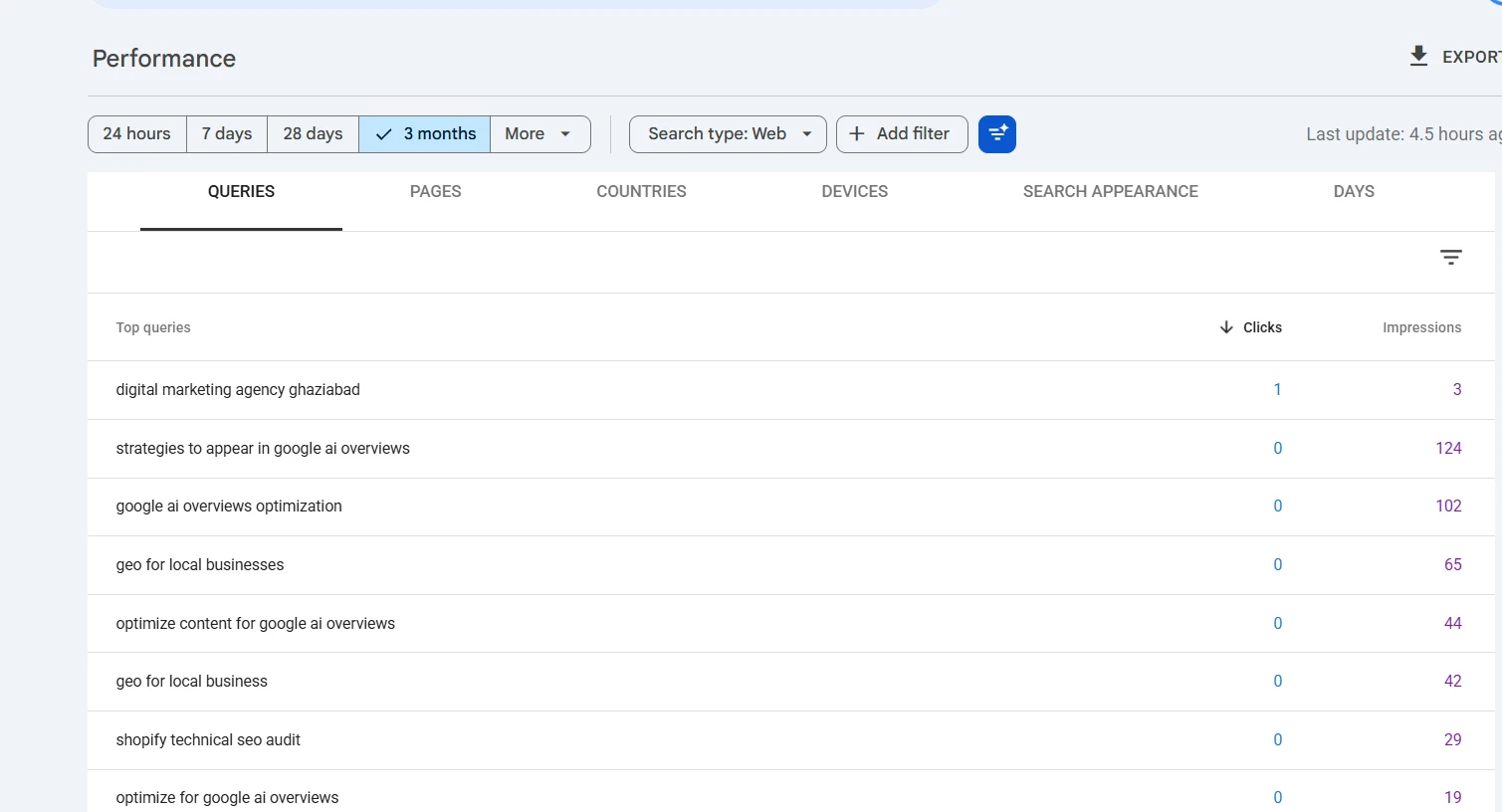
Turn on all four metrics
Select Total clicks, Total impressions, Average CTR and Average position so you can see all of them on the same chart.
Filter to the keyword or page that dropped
Click Add filter (or Add filter > Query) and enter the keyword your tracker says dropped. If the keyword has too little data, filter by the Page that ranks for it instead. Match the country and device to what your tracker uses.
Look at the day of the "drop"
Open the Dates tab and find the day your tracker flagged. Compare it with the days before and after:
- Do impressions and clicks fall on that day, or stay in their normal range?
- Does average position move noticeably, or stay roughly flat?
- Is the dip gone a day or two later?
Zoom out and compare periods
Set the date range to the last 28 days, then use Compare to line it up against the previous period. A real ranking problem shows up as a steady change over several days, not a single spike.
Wait three days before you act
Many of the reported poisoned results cleared within three days. If a drop disappears by itself, you were looking at noise. If it's still there after three days and Search Console agrees, treat it as real.
How to read the result
| Tracker says | Search Console shows | Most likely meaning | What to do |
|---|---|---|---|
| Big drop for one day | Impressions and clicks flat, position steady | Bad tracker check | Ignore it. Re-check in 2 to 3 days. |
| Drop lasts several days | Impressions, clicks and position all fall | Real ranking change | Investigate the page. See the next section. |
| Drop for many keywords at once | Mixed, little change in total clicks | Probably tracker noise, or a short Google test | Compare totals. Wait a few days. |
| Rank looks stable | Clicks falling | A click problem, not a ranking one (AI answers, a new feature, a weaker title) | Look at CTR and the page's snippet. Our post on AI Overviews on brand searches can help. |
| No data for the keyword | No rows | Inconclusive | A missing row is not proof either way. Check the page instead. |
Don't assume everything is noise. Google finished its September spam update recently (read our guide to what it targets), and site owners reported real volatility on 15 October. If Search Console confirms a drop that lasts, look at the page itself: indexing, content quality, and technical basics such as Core Web Vitals and JavaScript rendering.
What Search Console can't tell you
Search Console is the best reference we have, but it isn't a tracker. Keep these limits in mind:
- Average position is an average. It blends every search, country and device that showed your page. It will never match the single position your tracker saw.
- Low-volume queries may be missing. Google doesn't show every query, so "no data" is not the same as "no traffic".
- Dates use Pacific Time. If your tracker records dates in another time zone, one "day" can fall across two. Align them before comparing.
- Recent days can be incomplete. The last day or two may change as data arrives.
- It reports your site only. It can't tell you what competitors are doing.
If you are new to the report itself, our SEO for beginners guide explains the basics.
What to do with your rank tracker
- Don't report daily swings. Look at a 7 to 14 day trend and confirm it in Search Console before you tell a client.
- Track outcomes, not just positions. Clicks, impressions, leads and sales in your own analytics are harder to fake than a rank.
- Ask your tool how it handles this. Does it re-check suspicious pages? Does it flag a sudden loss of most usual competitors? Semrush told its users to report inconsistencies so its team can check each case.
- Compare more than one source. If two tools and Search Console agree, the data is more trustworthy.
- Mark the dates. Note in your reports that late September and October 2026 had unusual tracking noise, so future you doesn't blame the wrong change.
A 10-minute weekly check
Copy this into a spreadsheet and fill it in once a week.
| Keyword or page | Tracker change (7 days) | GSC clicks change | GSC impressions change | GSC position change | Verdict (noise / real / unclear) |
|---|---|---|---|---|---|
FAQ
Is Google really feeding rank trackers fake results?
Nozzle and other firms report that Google sometimes returns wrong results to automated collectors. In the reports I read, Google hasn't commented publicly, and Semrush says the impact on its users has been limited. Treat it as reported and uneven, not as confirmed policy.
How do I know if my ranking drop is real?
Check Search Console for the same query or page, country and device. If clicks, impressions and position stay steady, the drop is probably tracker noise. If they fall and stay down for more than a few days, it is probably real.
Does Search Console show my exact ranking?
No. It shows an average position across all the searches, devices and locations where your page appeared, so it will not match a tracker's single check. Use it to see direction and size of change, not an exact number.
How long does a poisoned result last?
According to Nozzle, about 80% lasted a single collection, and on 77.9% of affected pages the usual sites returned within three days. That is why waiting a few days before acting is a good rule.
Should I stop using my rank tracker?
No. Trackers are still useful for trends and competitors. Look at several days, confirm big changes in Search Console, and ask your vendor how it handles suspicious results.
What if Search Console also shows a drop?
Then treat it as real. Check that the page is still indexed, whether the content or technical setup changed, and whether a Google update is rolling out, then fix what you find.
Why is Search Console missing some of my keywords?
Google doesn't report every query, especially rare ones. A missing row doesn't mean you have no impressions, so check the page's overall numbers instead.
Need reporting you can trust?
We track the numbers that matter, confirm them in Search Console, and explain what they do and don't tell us. See our SEO services.
Talk to Us About SEO ReportingSources
- Search Engine Journal: Analysis: Google Is Poisoning Search Results For Rank Trackers (14 Oct 2026, Roger Montti)
- PPC Land: Google feeds rank trackers swapped results on 8% of pages, Nozzle finds (19 Oct 2026)
- Search Engine Watch: Semrush says Google is feeding rank trackers bad results, but impact is limited (19 Oct 2026, Martin Ashmere)
- DesignRush: Google Rankings Swing, ChatGPT Mislabels Traffic: SEO Roundup (19 Oct 2026, updated 20 Oct)
- DEV Community: Rank Trackers Are Getting Poisoned Google SERPs. Here's How I Check Drops With the Search Console API (Vishal Chauhan)
- Google Search Console Help: Performance report (Search results)